Cost of services
How Much Do Braces Cost in Canada? (2026 Price Guide)


Braces in Canada run anywhere from $5,000 to $10,000, sometimes more, depending on the type you get, how complicated your case is, and where you live. Metal braces are the most affordable option, usually starting around $5,000 for a fairly simple case. Ceramic braces run slightly higher, and lingual braces (the kind placed behind your teeth) can go well beyond $12,000. The
does not currently cover orthodontic treatment for adults, and private dental insurance plans typically apply a lifetime maximum of $1,500–$3,000 toward orthodontics, meaning a significant portion of the cost of orthodontics for teeth usually comes out of pocket, regardless of your coverage.
Braces Cost Breakdown by Type
Braces are fixed orthodontic appliances bonded directly to your teeth. Brackets go on each tooth, a wire runs through them, and that wire does the work of slowly moving your teeth over months or years. You can't take them out, and your orthodontist adjusts them every few weeks throughout treatment.
Which type your orthodontist recommends comes down to your case: how much movement is needed, whether bite correction is involved, and what your priorities are around visibility and budget.
Which type your orthodontist recommends comes down to your case: how much movement is needed, whether bite correction is involved, and what your priorities are around visibility and budget.
| Type | Without Insurance | With Insurance (est.) | Treatment Duration |
|---|---|---|---|
| Traditional metal braces | $5,000 – $8,000 | $3,500 – $6,500 | 18 months – 3 years |
| Ceramic (clear) braces | $5,500 – $9,000 | $4,000 – $7,500 | 18 months – 3 years |
| Self-ligating braces | $5,000 – $9,000 | $3,500 – $7,500 | 16 months – 2.5 years |
| Lingual braces | $8,000 – $13,000 | $6,500 – $11,500 | 18 months – 3 years |
Traditional Metal Braces
These are what most people picture when they think of braces. Stainless steel brackets, metal wire, the works. They're the most affordable type and work well for pretty much any case, from mild crowding to serious bite issues that clear aligners simply can't handle. In Canada, metal braces typically cost between $5,000 and $8,000.If your case involves anything beyond cosmetic alignment (an overbite, underbite, crossbite, or significant crowding) this is probably what your orthodontist will recommend.
Ceramic (Clear) Braces
Ceramic braces work exactly the same way as metal ones, just with tooth-coloured or clear brackets instead of silver. From across the room, they're much less obvious. They cost a bit more, usually $5,500 to $9,000 in Canada, and there are a couple of practical downsides worth knowing: the brackets stain if you drink a lot of coffee or red wine, and they're more fragile than metal, so a broken bracket is more likely to happen and costs more to fix.Self-Ligating Braces
Self-ligating braces (the Damon system is a well-known example) use a small built-in clip to hold the wire instead of the elastic bands that standard braces use. Some orthodontists say this creates less friction and requires fewer trips in for adjustments. The research on whether they actually move teeth faster is pretty inconclusive, but a lot of patients say they're more comfortable day-to-day. Cost-wise, they fall in a similar range to ceramic braces, roughly $5,000 to $9,000.Lingual Braces
Lingual braces are fitted to the back surfaces of your teeth, so nobody can see them at all. The reason they cost so much (typically $8,000 to $13,000) is that every single bracket has to be custom-made to fit the inside of each tooth. Not every orthodontist offers them, and the adjustment period is rougher than standard braces. Most people go through a few weeks of awkward speech while their tongue adjusts. If being completely invisible is the goal and the price isn't the deciding factor, this is the only fixed option that gets you there.What's Actually Included in Your Quote?
This is something most people don't think to ask about until they get a surprise bill, and it's worth sorting out upfront.
Two practices can quote $6,000 and $7,500 for what sounds like the same treatment. Once you read what's included in each, the more expensive one sometimes works out cheaper. Orthodontic quotes differ a lot in what they bundle versus what gets added on later.
Two practices can quote $6,000 and $7,500 for what sounds like the same treatment. Once you read what's included in each, the more expensive one sometimes works out cheaper. Orthodontic quotes differ a lot in what they bundle versus what gets added on later.
What's usually in the quoted price:
- Initial records (X-rays, photos, digital scans or impressions)
- All the hardware: brackets, wires, bands
- Regular adjustment appointments throughout treatment
- One set of retainers when treatment ends (at many practices, but not all)
What often isn't:
- The first consultation ($0–$150 depending on the practice)
- Replacement retainers if one breaks or gets lost
- Emergency visits for broken brackets or a wire that's come loose
- Extra time in treatment if your teeth move slower than expected
- Teeth whitening, which some practices throw in as a promotion but may bill separately
Two questions to ask before you sign:
- First: are retainers included? You'll need them no matter what, so if they're not in the quote, add $300–$900 to your total depending on the type and how many arches you need.
- Second: what happens if treatment runs over? Some orthodontists absorb that cost. Others charge per appointment past the original end date. For anyone with a complex case, this is worth pinning down in writing.
Braces vs. Invisalign: Cost Comparison in Canada
The choice between braces and Invisalign is one of the most common questions before starting orthodontic treatment. Cost is part of the picture, but it's not the whole story. Here's how they compare:
| Treatment | Best For | Typical Cost in Canada | Visibility | Removable? | Treatment Duration |
|---|---|---|---|---|---|
| Metal braces | Most cases, including complex bite correction | $5,000 – $8,000 | Visible | No | 18 months – 3 years |
| Ceramic braces | Adults wanting a discreet fixed option | $5,500 – $9,000 | Less visible | No | 18 months – 3 years |
| Lingual braces | Maximum discretion, flexible budget | $8,000 – $13,000 | Invisible | No | 18 months – 3 years |
| Invisalign Lite | Mild crowding, minor spacing issues | $3,000 – $4,500 | Nearly invisible | Yes | 6 – 12 months |
| Invisalign Comprehensive | Moderate cases in compliant patients | $5,000 – $8,000 | Nearly invisible | Yes | 12 – 18 months |
Note:
Invisalign only works if you actually wear the aligners. They need to be in 20–22 hours a day. People who fall short of that often end up needing extra aligner trays mid-treatment, called refinements, which can tack on another $500–$1,500 if they're not included in the original plan. Braces don't have that problem. They're on your teeth around the clock whether you like it or not.
For a full breakdown of Invisalign costs by treatment type and province, see our .
How Age Affects the Cost of Braces
Braces aren't just for teenagers, even if it can feel that way. The treatment looks a bit different and costs a bit differently depending on how old the patient is.
However, Phase 1 doesn't replace full braces later. Most kids who go through it still need comprehensive treatment as a teenager. You're paying for two courses of treatment years apart. Not every child referred early actually needs Phase 1. It's genuinely the right call in some situations, but it gets recommended sometimes when waiting would reach the same outcome at no extra cost. A second opinion before committing is always reasonable.
Cost for teens is broadly in the same range as adults. If you have more than one child who'll need treatment, ask whether the practice offers any kind of family pricing. Some do.
Adult treatment usually costs 10–20% more than the same treatment in a teenager and takes longer. Adult bone is denser, so teeth move more slowly. A case that might wrap up in 18 months for a 16-year-old can take 24–30 months for a 40-year-old. On top of that, adults sometimes need a periodontal check before treatment can start. If there's any gum disease, that gets treated first. And if teeth need to be extracted to make room, add $200–$400 per tooth.
None of that should put you off. It just means going into a consultation with a realistic sense of the timeline and the full cost.
Braces for Children (Under 12)
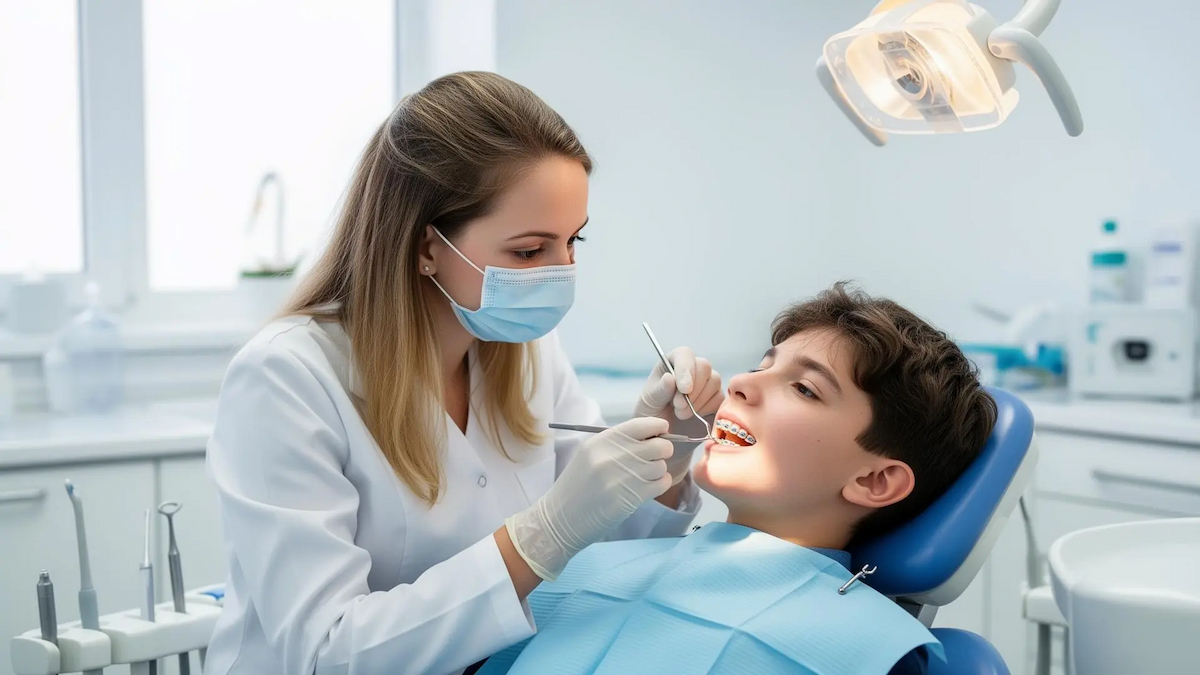
Some kids get referred to an orthodontist before all their adult teeth are in. In those cases, the orthodontist might recommend what's called Phase 1 or interceptive orthodontics: a shorter round of treatment using partial braces, palate expanders, or removable appliances to address a specific problem, like a severe crossbite or a jaw that's developing unevenly. This typically runs $2,000–$4,500.However, Phase 1 doesn't replace full braces later. Most kids who go through it still need comprehensive treatment as a teenager. You're paying for two courses of treatment years apart. Not every child referred early actually needs Phase 1. It's genuinely the right call in some situations, but it gets recommended sometimes when waiting would reach the same outcome at no extra cost. A second opinion before committing is always reasonable.
Braces for Teenagers
Most orthodontic treatment in Canada happens during the teen years. All the adult teeth are in, the jaw is still developing, and tooth movement tends to be faster and more predictable than it is in adults. Metal braces are the most common choice, though some practices offer Invisalign Teen for older teenagers who are likely to wear their aligners consistently (see our Invisalign cost guide for how that compares).Cost for teens is broadly in the same range as adults. If you have more than one child who'll need treatment, ask whether the practice offers any kind of family pricing. Some do.
Braces for Adults
More adults get braces than most people realize. Some never had treatment as kids, some dealt with relapse after earlier treatment, and some are only finding out now that a bite issue has been quietly causing problems.Adult treatment usually costs 10–20% more than the same treatment in a teenager and takes longer. Adult bone is denser, so teeth move more slowly. A case that might wrap up in 18 months for a 16-year-old can take 24–30 months for a 40-year-old. On top of that, adults sometimes need a periodontal check before treatment can start. If there's any gum disease, that gets treated first. And if teeth need to be extracted to make room, add $200–$400 per tooth.
None of that should put you off. It just means going into a consultation with a realistic sense of the timeline and the full cost.
Braces Costs by Province
Provincial dental associations publish suggested fee guides that cover most dental procedures, but full orthodontic treatment isn't priced at a fixed rate in any of them. In Ontario, the specifically lists full orthodontic treatment as "Independent Consideration", meaning the provider sets the price based on how complex the case is. Other provincial guides take a similar approach. The guides do set suggested fees for things like retainers and appliances, but the main treatment cost is up to the practice.
What that means practically: what you pay depends a lot on where you live.
What that means practically: what you pay depends a lot on where you live.
| Province | Metal Braces | Ceramic Braces |
|---|---|---|
| Ontario | $5,000 – $8,500 | $6,000 – $9,500 |
| British Columbia | $5,500 – $9,000 | $6,000 – $10,000 |
| Alberta | $5,000 – $8,000 | $5,500 – $9,000 |
| Quebec | $4,500 – $7,500 | $5,000 – $8,500 |
| Manitoba | $4,000 – $6,500 | $4,500 – $7,000 |
| Saskatchewan | $3,800 – $6,500 | $4,300 – $7,000 |
| New Brunswick | $4,000 – $6,500 | $4,500 – $7,000 |
| Nova Scotia | $4,000 – $6,500 | $4,500 – $7,000 |
| Prince Edward Island | $3,800 – $6,000 | $4,200 – $6,500 |
| Newfoundland and Labrador | $4,000 – $6,500 | $4,500 – $7,000 |
These are general estimates. Your actual quote will depend on your specific case, the provider, and their current pricing. Always get a written quote before making any decisions.
What Affects the Cost of Braces?
The type of braces is the biggest single factor, but it's not the only one. Here's what else moves the number up or down:
The complexity of your case.
A few mildly crowded front teeth is a short, simple treatment. A significant overbite combined with jaw misalignment is longer and more involved. Your orthodontist's quote reflects the difficulty of what they're actually dealing with, not just the hardware.
Your orthodontist's experience and credentials.
A registered specialist orthodontist who completed additional years of training beyond dental school typically charges more than a general dentist offering orthodontic services. For complex cases, that expertise is usually worth the difference.
The technology used at the clinic.
Practices using digital 3D scanning, computer-aided treatment planning, and laser technology tend to charge more to cover that equipment. The benefit is often more precise treatment; whether it matters for your specific case is worth asking about.
Whether you need extras before or during treatment.
Some patients need palate expanders to widen the jaw before braces can go on, or spacers to create room between teeth. These are billed separately and can add $300–$800 or more. Extractions, fillings, or gum treatment required before orthodontics starts add to the total as well.
Where the clinic is located.
Practices in downtown Toronto or Vancouver carry significantly higher overhead than those in suburban or mid-sized cities, and that flows through to what patients pay. The same treatment from an equally qualified orthodontist can cost $1,000–$2,000 less in a suburban clinic than in a downtown one.
Does Insurance or the CDCP Cover Braces?
Private Employer Benefits Plans
Most mid-to-higher tier group dental plans include some orthodontic coverage. Usually, that means:- A lifetime maximum of $1,500–$3,000 per person for orthodontic costs
- Coverage of around 50% of eligible costs up to that cap
- A waiting period of 3–12 months before the orthodontic benefit kicks in
- Coverage for dependents under 18 or 21 on most plans (whether adults are covered varies a lot by plan)
The Medical Necessity Angle: Worth Asking About
Most insurers treat Invisalign as cosmetic and won't cover it beyond the standard orthodontic limit. Braces are different. When the case involves a real functional problem (a significant overbite, underbite, impacted teeth, or something that affects how you chew or speak) traditional braces are more often approved as medically necessary. That classification can move the claim out of the cosmetic/elective bucket and into better coverage.If your case involves any of those issues, ask your orthodontist whether it qualifies as medically necessary before the claim goes in. It doesn't apply to everyone, but for the people it does apply to, it can make a real difference to what gets covered.
Canadian Dental Care Plan (CDCP)
The for adults. For kids under 18 who qualify based on household income, there's limited orthodontic coverage available, but only for cases the plan considers medically necessary, and preauthorization is required. For most adults considering braces, isn't on the table.The one exception: adults with certain craniofacial conditions (cleft palate being one example) may qualify in specific circumstances. Check Health Canada's current 2026 guidelines if that applies to you.
Health Spending Accounts (HSAs)
If your employer offers an HSA, braces are an eligible expense. Since HSA funds come from pre-tax income, you're effectively getting a 25–45% discount depending on your tax bracket. If you have access to one, use it.Provincial Programs
A handful of provinces run dental programs for children from lower-income families that can offset some orthodontic costs. These programs change regularly in terms of scope and eligibility. Alberta, BC, and Ontario have had them at various points. Check your provincial health authority's website to see what's currently available.How to Make Braces More Affordable
Get quotes from at least three orthodontists:
Most initial consultations are free or cost $50–$150. Prices for the same treatment can vary by $1,000–$2,000 between practices in the same city. You won't know if a quote is reasonable until you have something to compare it to.
Ask about paying in installments:
Most orthodontic practices let you spread payments across the treatment period, usually interest-free. On a $6,500 treatment over 24 months, that works out to around $270 a month. It doesn't lower the total, but it makes a five-figure bill a lot more manageable.
Read the fine print on dental financing:
Medicard, Dentalcard, and PayBright all offer dental financing plans. The important thing to check is whether the offer is genuinely interest-free or whether it's deferred interest, where interest builds from day one and hits you all at once if you haven't paid off the balance before the promotional period ends. Don't just look at the headline. Read the contract.
Look into Smiles 4 Canada.
Run by the Canadian Foundation for the Advancement of Orthodontics (CFAO) in partnership with the Canadian Association of Orthodontists (CAO), provides orthodontic treatment at no cost (beyond a one-time $600 administrative fee) to children from low-income families across Canada. Eligibility is based on the federal Low-Income Cut-Off thresholds, and applicants must be between 7 and 14 years old (or up to 18 in Manitoba). Applications are accepted annually, typically between January and May. Competition is high and spots are limited, but for families who qualify, it's one of the most significant orthodontic cost offsets available in Canada.
First Nations and Inuit patients: check the NIHB programme.
The federal Non-Insured Health Benefits (NIHB) programme provides coverage for a range of dental services, including orthodontics, for registered First Nations and recognized Inuit clients. Covered dental services include orthodontic treatment such as braces, alongside diagnostic, preventive, restorative, and oral surgery services. Coverage is subject to predetermination and medical necessity criteria. For more information, visit the Indigenous Services Canada NIHB dental benefits page.
Look into dental school clinics:
University dental school clinics (including at the , UBC, the University of Alberta, McGill, and Dalhousie) offer orthodontic treatment at 30–50% less than private practice rates. It's supervised by licensed faculty, so the clinical standard is fine, but appointments take longer, wait lists can run several months, and overall treatment tends to take a bit more time. If you're not in a rush, the savings are real. We're talking potentially $2,000–$4,000 on the same treatment.
Use your HSA if you have one:
Straightforward and worth doing. The pre-tax savings add up.
Ask about paying the full amount upfront:
Some practices will knock 5–10% off for full payment at the start. They don't advertise it. Ask.
Time your start date around your insurance waiting period:
If you're a few months away from your benefits kicking in, starting treatment after that date rather than before could mean getting $1,500–$3,000 back on your claim.
Ready to get started? Tell your preferences in a provider, and get matched with the right orthodontist in your area.
Frequently Asked Questions

Easily find trusted dentists nearby

Personalized AI Matching
Easy Online Booking
100% Free
Related Articles



Find the Right Dentist Instantly
Tell us what you need, and Denzy searches every clinic near you and matches you to the right one.

Personalized AI Matching

Easy Online Booking

100% Free