Oral Health
Types of Dental Crowns: Which Material Is Right for Your Tooth?


Choosing a dental crown isn't quite as straightforward as picking one off a list. The right material depends on where the tooth is, how much pressure it takes during chewing, how visible it is when you smile, and what you're willing to spend. Some materials prioritize strength, others offer a more natural appearance, and a few are intended only as temporary solutions. This guide covers the main types of dental crowns, what each one offers, and .
f you'd prefer help finding a dentist, can match you with who provide crown treatments suited to your needs, rather than leaving you to sort through a long list of clinics yourself.
f you'd prefer help finding a dentist, can match you with who provide crown treatments suited to your needs, rather than leaving you to sort through a long list of clinics yourself.
What Does a Dental Crown Actually Do?
A dental crown is essentially a cap that fits over a tooth when it's too damaged, weakened, or worn to be restored reliably with a alone. It covers the visible part of the tooth above the gumline, restoring its shape and strength while helping protect the natural tooth structure underneath.
Crowns are also commonly recommended after a , since the remaining tooth may be more vulnerable to fractures, particularly when a substantial amount of its structure has already been lost. They can also be used to cover dental implants or support a dental bridge.
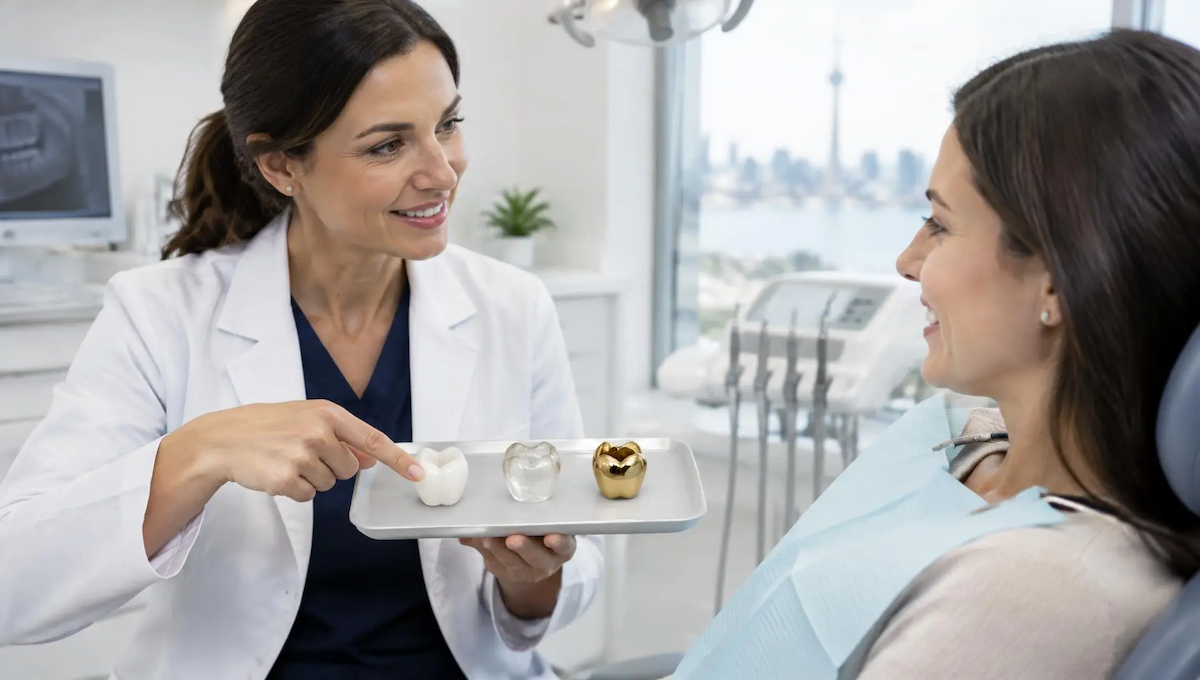
The biggest difference between crown types comes down to the material they're made from. That choice affects how natural the crown looks, how well it holds up to everyday chewing, and, of course, how much it costs.
Porcelain-Fused-to-Metal (PFM) Crowns
Porcelain-fused-to-metal crowns have been used in dentistry for decades, and for good reason. They combine a strong metal base with a porcelain outer layer that gives the crown a tooth-coloured appearance. This combination offers a reasonable balance between durability and aesthetics, without the price tag of some newer materials.
PFM crowns generally handle normal chewing forces well and remain a common choice for permanent restorations. One drawback is that the metal underneath can sometimes become visible as a thin dark line along the gumline, particularly if the gums recede over time.
PFM crowns generally handle normal chewing forces well and remain a common choice for permanent restorations. One drawback is that the metal underneath can sometimes become visible as a thin dark line along the gumline, particularly if the gums recede over time.
Best suited for:
Back teeth that need a durable restoration, especially when keeping costs manageable matters more than achieving a completely metal-free appearance.
Typical cost:
$900 to $1,600.
All-Porcelain (All-Ceramic) Crowns
All-porcelain crowns don't have a metal base, which allows them to mimic the natural translucency of teeth more closely. This is particularly useful for front teeth, where even small differences in colour or light reflection can be noticeable when you smile or speak.
Their main advantage is appearance, but there is a trade-off. Depending on the specific ceramic material and the forces placed on the tooth, an all-porcelain crown may be more vulnerable to chipping or fracture than a metal alloy crown or certain zirconia options. That doesn't mean it's unsuitable for everyday use; it simply means your dentist needs to consider your bite and the location of the tooth before recommending it.
Their main advantage is appearance, but there is a trade-off. Depending on the specific ceramic material and the forces placed on the tooth, an all-porcelain crown may be more vulnerable to chipping or fracture than a metal alloy crown or certain zirconia options. That doesn't mean it's unsuitable for everyday use; it simply means your dentist needs to consider your bite and the location of the tooth before recommending it.
Best suited for:
Front teeth and other visible areas where a natural-looking restoration is a priority.
Typical cost:
$1,100 to $1,800.
Zirconia Crowns
Zirconia crowns are made from a strong, metal-free ceramic material. They're particularly popular for molars, which take considerable pressure during chewing, because they can provide excellent strength without the need for a metal base.
They also offer a more natural appearance than traditional metal crowns. However, zirconia doesn't always have the same translucency as some all-porcelain materials, so the final result can look slightly different from a natural tooth when examined closely. Newer zirconia materials and careful shade matching can help improve the appearance.
For patients who need a durable crown but would rather avoid metal, zirconia is often worth discussing with their dentist.
Best suited for:
Back teeth exposed to substantial chewing forces, or anyone looking for a strong, metal-free crown.
Typical cost:
$1,000 to $2,000.
Gold or Metal Alloy Crowns
Gold and other metal alloy crowns aren't designed to blend in with your natural teeth. Their advantage lies elsewhere: they're extremely durable, can withstand heavy chewing forces, and may last for decades with proper care.
Another benefit is that metal crowns can often be placed while removing less healthy tooth structure than would be needed for some other crown designs. They're particularly useful for back molars, where appearance is less of a concern and strength matters more.
The obvious downside is their colour. Gold crowns are visible when you open your mouth wide or smile, which is why many patients prefer tooth-coloured alternatives, especially for teeth closer to the front.
Best suited for:
Back molars where durability and preserving tooth structure are priorities, and the metallic appearance isn't a concern.
Typical cost:
$900 to $1,800.
Composite Resin Crowns (Temporary)
Composite resin crowns are made from a tooth-coloured material similar to the resin used in dental fillings. Unlike the permanent crown materials discussed above, they're generally intended as a short-term solution rather than a restoration that will last for years.
After your dentist prepares a tooth for a permanent crown, a dental laboratory usually needs a couple of weeks to fabricate it. A temporary composite crown protects the prepared tooth during that waiting period, helping maintain function and reduce sensitivity.
Although composite resin can be useful in this situation, it isn't as durable as most permanent crown materials and can wear, chip, or break more easily. It's generally not the first choice for a long-term restoration.
Best suited for:
Protecting a prepared tooth while your permanent crown is being made.
Typical cost:
$400 to $800.
Stainless Steel Crowns (For Children's Teeth)
Stainless steel crowns are different from the other options on this list because they're primarily used for children's primary, or baby, teeth. Rather than making a custom crown for each child, the dentist selects a prefabricated metal crown and fits it over a badly decayed or damaged baby molar.
The aim is to protect the tooth until it falls out naturally and the permanent tooth takes its place. This can be especially useful when decay is too extensive for a filling to provide a reliable restoration. Keeping the baby tooth in place also helps preserve space for the incoming adult tooth.
Stainless steel crowns aren't intended as a permanent solution for adult teeth, nor are they chosen for cosmetic reasons. Their value lies in being practical, durable, and effective for treating certain dental problems in children.
Best suited for:
Children with a badly decayed or broken primary molar that isn't ready to fall out naturally.
Typical cost:
Alberta's 2026 dental fee guide lists a suggested fee of $258.70 for a stainless steel crown on a back primary tooth. Costs in other provinces vary by clinic and local fee schedules, but may fall within a broadly similar range.
Crown Material Cost Comparison
| Material | Best For | Typical Cost (2026) | Durability |
|---|---|---|---|
| Composite resin | Temporary protection while a permanent crown is made | $400 to $800 | 2 to 4 weeks |
| Porcelain-fused-to-metal (PFM) | Back teeth needing strength and a tooth-coloured surface | $900 to $1,600 | 10 to 15 years |
| Gold or metal alloy | Back molars where appearance is less important | $900 to $1,800 | 20 years or more |
| Zirconia | Back teeth exposed to heavy chewing forces | $1,000 to $2,000 | 15 years or more |
| All-porcelain or ceramic | Front teeth where appearance matters most | $1,100 to $1,800 | 10 to 15 years |
These figures are estimates, and the final bill may include more than the crown itself. If the tooth has lost a significant amount of its structure, your dentist may need to build it up with a core or post before placing the crown. This can add around $200 to $500. Dental laboratory fees may also be charged separately, often adding another $250 to $500.
It's worth asking for an itemized treatment estimate so you know exactly what's included in the quoted price.
It's worth asking for an itemized treatment estimate so you know exactly what's included in the quoted price.
Dental Crown Cost by Province
Dental crown costs vary across Canada, partly because provincial fee guides and individual dental practices don't all charge the same rates. The following figures provide a general comparison of typical total costs, including laboratory fees.
| Province | Typical Crown Cost (Total, Including Lab Fee) |
|---|---|
| Ontario | $1,417 to $1,517 |
| Alberta | $1,373 to $2,196 |
| British Columbia | $1,431 to $1,753 |
| Quebec | $900 to $1,500 |
| New Brunswick | $1,309 to $1,409 |
| Nova Scotia | $1,223 to $1,323 |
| Prince Edward Island | $1,160 to $1,260 |
| Manitoba | $900 to $2,000 |
| Saskatchewan | $900 to $2,000 |
| Newfoundland and Labrador | $900 to $2,000 |
| National Range | $900 to $2,000 |
The figures for Ontario, Alberta, British Columbia, Quebec, New Brunswick, Nova Scotia, and Prince Edward Island are based on specific provincial figures. For Manitoba, Saskatchewan, and Newfoundland and Labrador, independently confirmed figures weren't available for this comparison, so the general national range has been used instead.
Keep in mind that these are broad estimates, not guaranteed quotes. The type of crown, the condition of your tooth, and any additional work needed can all affect the final price. Two clinics in the same city may also charge different amounts for similar treatment.
Since a dental crown can be a significant expense, getting more than one estimate may be worthwhile. can help you find dentists near you and check which providers accept CDCP, giving you a starting point for exploring local treatment options.
How Dentists Choose the Right Crown Material
There isn't one crown material that's best for every tooth. Dentists usually consider a combination of practical factors before making a recommendation.
Where is the tooth located?
Front teeth are often restored with all-porcelain crowns because of their natural appearance. Back teeth, especially molars, experience greater chewing forces, so zirconia, gold, or porcelain-fused-to-metal may be more suitable depending on the individual case.
Do you grind or clench your teeth?
If you regularly clench your jaw or grind your teeth at night, your crown may be exposed to extra pressure. A strong material, such as zirconia or a metal alloy, may be worth considering. Your dentist may also recommend a night guard to help protect the restoration.
How important is appearance?
If the tooth is visible when you smile or talk, a tooth-coloured material will usually be more appealing than gold or a crown with a visible metal margin. All-porcelain and zirconia are two options to discuss, although the best choice depends on the tooth's position and bite.
What's your budget?
Composite resin is generally the least expensive option in this comparison, but it's usually temporary. Permanent crowns have different price points, with the final cost depending on the material, laboratory fees, and any additional treatment needed. Choosing the cheapest option isn't necessarily the most economical decision over the long term if it isn't appropriate for your tooth.
Is the crown for a child?
When a baby tooth has extensive decay, a stainless steel crown may be the most practical option. The goal is to protect the tooth until it falls out naturally, rather than provide a permanent cosmetic restoration.
Once you have an idea of which material might work for you, a dental examination is the best way to narrow down the options. can help you find a dentist near you who provides crown treatment and discuss your options in person.
Does CDCP or Insurance Cover Dental Crowns?
The may help reduce the cost of a dental crown for eligible patients, but coverage is subject to specific rules. Crowns are considered major dental services rather than routine preventive care, and the amount CDCP pays depends on your adjusted family net income and the program's applicable fee schedule.
The general income-based reimbursement structure is outlined below.
These percentages apply only if you meet the program's other eligibility requirements. Having access to private dental insurance through your own employer, a spouse's employer, or a pension plan can affect eligibility, so it's important to check the current rules before assuming you qualify.
CDCP also has specific restrictions for crowns. Under the coverage rules described here, eligible patients may be limited to four crowns within a 10-year period, with generally no more than one crown per tooth within an eight-year period. Preauthorization is required before treatment begins. Implant-supported crowns, three-quarter crowns, and crowns placed solely for cosmetic reasons are excluded under the stated criteria.
Even when a crown is covered, you may still have to pay part of the bill. CDCP reimbursement is calculated using its own fee guide, and a dentist may charge more than the amount recognized by the plan. The difference, along with any applicable patient copayment, can leave you with an out-of-pocket expense.
Private dental insurance may also help. Crowns are usually classified as major or restorative services, with many plans reimbursing around 50% to 70% of eligible costs. That's often less than the coverage available for basic procedures such as fillings and cleanings.
Annual maximums are another consideration. Many private plans cap total dental reimbursements at around $1,500 to $2,500 per year, depending on the policy. A single crown can use up a substantial portion of that allowance, particularly if you need other dental work in the same year.
Before scheduling treatment, ask your dentist for a detailed estimate and check with your insurer or CDCP administrator about eligibility, preauthorization, reimbursement limits, and any fees you may have to pay yourself.
The general income-based reimbursement structure is outlined below.
| Adjusted Family Net Income | CDCP Covers | You Cover |
|---|---|---|
| Under $70,000 | 100% of the CDCP fee guide rate | 0% (plus any fee gap) | $70,000 to $79,999 | 60% of the CDCP fee guide rate | 40%, plus any fee gap | $80,000 to $89,999 | 40% of the CDCP fee guide rate | 60%, plus any fee gap | $90,000 and above | Not eligible for CDCP | Full cost |
CDCP also has specific restrictions for crowns. Under the coverage rules described here, eligible patients may be limited to four crowns within a 10-year period, with generally no more than one crown per tooth within an eight-year period. Preauthorization is required before treatment begins. Implant-supported crowns, three-quarter crowns, and crowns placed solely for cosmetic reasons are excluded under the stated criteria.
Even when a crown is covered, you may still have to pay part of the bill. CDCP reimbursement is calculated using its own fee guide, and a dentist may charge more than the amount recognized by the plan. The difference, along with any applicable patient copayment, can leave you with an out-of-pocket expense.
Private dental insurance may also help. Crowns are usually classified as major or restorative services, with many plans reimbursing around 50% to 70% of eligible costs. That's often less than the coverage available for basic procedures such as fillings and cleanings.
Annual maximums are another consideration. Many private plans cap total dental reimbursements at around $1,500 to $2,500 per year, depending on the policy. A single crown can use up a substantial portion of that allowance, particularly if you need other dental work in the same year.
Before scheduling treatment, ask your dentist for a detailed estimate and check with your insurer or CDCP administrator about eligibility, preauthorization, reimbursement limits, and any fees you may have to pay yourself.
Frequently Asked Questions

Easily find trusted dentists nearby

Personalized AI Matching
Easy Online Booking
100% Free
Related Articles




Find the Right Dentist Instantly
Tell us what you need, and Denzy searches every clinic near you and matches you to the right one.

Personalized AI Matching

Easy Online Booking

100% Free